Can Ancient Vastu Science and Modern Architecture Coexist?
Few topics generate more debate in South Indian architecture and interior design than Vastu Shastra. For some homeowners, it is an inviolable system of spatial wisdom accumulated over millennia. For others, it is superstition dressed in the language of architecture. For most families, the reality lies somewhere in between — a genuine desire to honour cultural tradition without sacrificing functional design.
The good news: when approached thoughtfully, Vastu and contemporary architecture are far more compatible than either camp tends to admit.
The 8 Directions: Vastu Room Placement Decoded
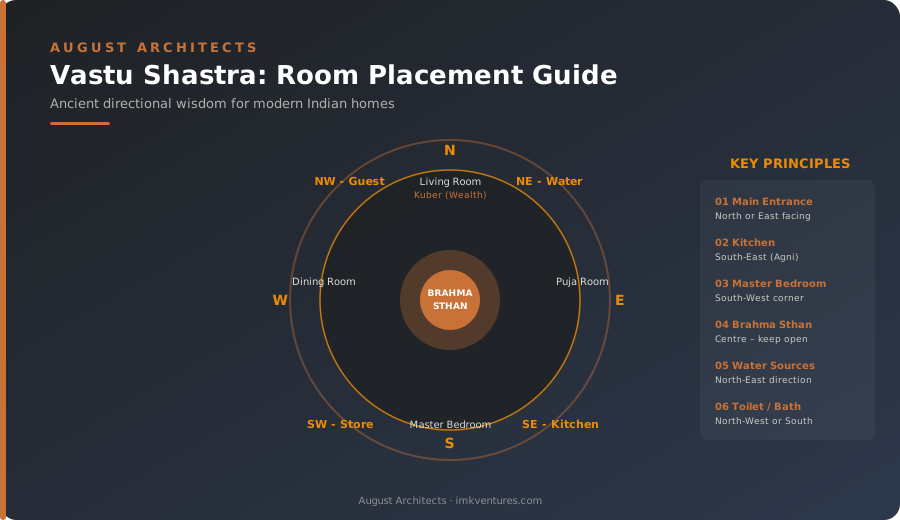
The Vastu Purusha Mandala divides a plot into eight compass directions, each governed by a presiding deity and associated with specific functions. Interpreted practically:
- North (Kubera): Wealth and prosperity; ideal for the main entrance, living rooms, or study
- Northeast (Ishanya): The most sacred quadrant; reserve for the pooja room, meditation space, or water storage
- East (Indra): Sunrise direction; ideal for bathrooms, balconies, and spaces requiring morning light
- Southeast (Agni): Fire zone; the kitchen belongs here, as does electrical equipment
- South (Yama): Associated with permanence; suitable for master bedroom, heavy storage
- Southwest (Niriti): Stability and strength; master bedroom is also appropriate here; avoid water bodies
- West (Varuna): Water and rains; suitable for dining, children’s rooms, and study
- Northwest (Vayu): Movement and change; appropriate for guest rooms, garages, and service areas
Brahma Sthan: The Sacred Centre
The Brahma Sthan is the central zone of a Vastu-compliant plot — the area that should remain open, unobstructed, and light-filled. It is associated with Brahma, the creator, and is considered the energetic heart of the home. In practical architectural terms, this often translates to an internal courtyard, a central skylight, or a light well at the heart of the plan.
Far from being an arbitrary constraint, this principle aligns beautifully with passive design logic: a central open space improves cross-ventilation, brings daylight to interior rooms, and creates a thermal buffer. Many traditional South Indian home designs — the Nalukettu of Kerala, the Chettiar homes of Tamil Nadu — embody this principle instinctively.
When Plot Orientation Doesn’t Cooperate
Urban plots rarely offer the ideal orientation. A south-facing main entrance (considered suboptimal in Vastu) is actually excellent from a passive design standpoint. A west-facing plot presents challenges both architecturally and in Vastu. The resolution is the same in both disciplines: use landscaping, planning, and architectural elements to manage the problematic orientation. An architect experienced in both Vastu and passive design can propose:
- Buffer zones (garages, utility rooms, storage) placed on the unfavourable elevation
- Internal courtyard or atrium adjusted to bring the Brahma Sthan to an optimal position relative to the Vastu grid
- Compensating elements: a water feature in the northeast, heavier planting to the west, a pooja room positioned to align with northeast regardless of entrance
- Remedial Vastu: some Vastu practitioners advise specific yantras or structural adjustments; discuss these with your Vastu consultant before incorporating them architecturally
Vastu Shastra: The 8 Directional Map
Design a Home That Aligns Energy and Architecture
August Architects combines Vastu wisdom with contemporary architectural excellence — creating homes that honour tradition while delivering modern spatial quality and performance.