Why Green Building Materials Matter More Than Ever in 2026
The construction industry accounts for approximately 38% of global carbon dioxide emissions. In India, where urbanisation is accelerating at one of the fastest rates in the world, the materials we choose to build with have implications that extend far beyond any individual project.
Green building materials are no longer a niche consideration for eco-conscious clients. Driven by GRIHA and LEED certification demand, rising energy costs, and increasing regulatory focus on embodied carbon, they are becoming mainstream. Here are the six materials most relevant to construction in Karnataka right now.
6 Green Materials Transforming Karnataka Construction
1. Autoclaved Aerated Concrete (AAC) Blocks
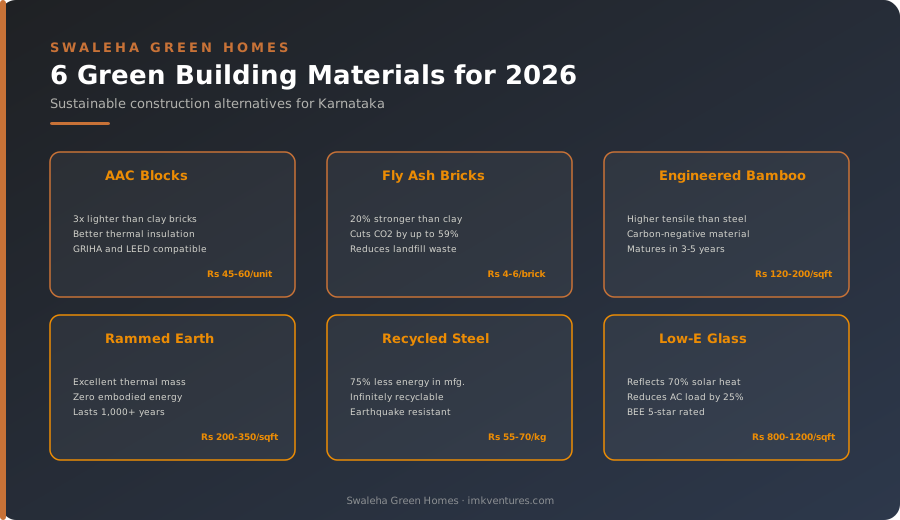
AAC blocks have become the dominant walling material for premium construction in Bangalore and across Karnataka. Made from a mixture of cement, fly ash, lime, and aluminium powder that is autoclaved under pressure, they are approximately 3–5 times lighter than traditional red brick. This weight reduction translates directly into reduced structural steel requirements and reduced foundation loads. Their thermal insulation value (U-value) is significantly better than brick, reducing cooling loads. AAC blocks also have excellent fire resistance, decent sound attenuation, and are dimensionally precise — requiring less plaster to achieve a flat finish. Their carbon footprint is lower than conventional bricks by approximately 30–40%.
2. Fly Ash Bricks
Fly ash bricks are made from fly ash — a byproduct of coal-fired thermal power plants — mixed with lime, gypsum, and water, and then compressed under high pressure. They repurpose an industrial waste material that would otherwise be landfilled. Fly ash bricks have a higher compressive strength than conventional clay bricks, better dimensional consistency, lower water absorption, and comparable thermal properties to standard brickwork. Their embodied carbon is significantly lower than fired clay brick because they require no kiln-firing. They are widely available across Karnataka and typically cost 15–25% less than AAC blocks, making them an accessible green alternative at the economy to standard grade.
3. Engineered Bamboo
Bamboo is one of the fastest-growing plants on earth — some species grow up to a metre per day — and sequesters more carbon per unit area than most timber species. Engineered bamboo products (strand-woven bamboo, cross-laminated bamboo) achieve mechanical properties comparable to or exceeding many hardwoods, with bending strength exceeding oak. In Karnataka and Goa, bamboo is increasingly used for interior flooring, wall cladding, ceiling linings, furniture, and structural elements in smaller outbuildings. Unlike traditional bamboo, engineered bamboo is dimensionally stable and resistant to insects and moisture when properly treated.
4. Rammed Earth
Rammed earth — the ancient technique of compressing moistened subsoil in formwork to create solid, dense walls — is experiencing a significant revival in contemporary architecture. Modern stabilised rammed earth (SRE) adds a small proportion of cement or lime to the mix, significantly improving strength and durability while preserving the material’s natural aesthetic. Rammed earth walls provide exceptional thermal mass, excellent acoustic isolation, zero waste (the material is typically sourced from the excavation of the same site), and a beauty that is entirely specific to the place — the colour and texture vary with the local geology. Several August Architecture projects in Bangalore and Goa have incorporated rammed earth as primary wall surfaces and internal feature walls.
5. Recycled Steel and Low-Carbon Concrete
Steel production is responsible for approximately 7–8% of global CO₂ emissions. Recycled steel — produced from scrap metal in electric arc furnaces rather than from virgin iron ore in blast furnaces — has an embodied carbon footprint approximately 60–75% lower than primary steel. In structural applications, specifying recycled content TMT bars (most Indian TMT manufacturers now produce high-recycled-content steel) and ensuring that structural steel sections come from certified recycled sources are accessible green choices that cost nothing extra. In concrete, supplementary cementitious materials (SCMs) like fly ash and GGBS (ground granulated blast furnace slag) can replace 20–40% of Portland cement, significantly reducing the embodied carbon of structural concrete.
6. Low-E Double-Glazed Glass
Single-pane glass — still the default in much Indian residential construction — is thermally catastrophic: it allows almost all solar infrared radiation to pass through while also being a poor insulator. Low-emissivity (Low-E) double-glazed units address both problems. The low-E coating reflects infrared radiation back (keeping heat out in summer, retaining warmth in winter), while the air or argon gap between panes provides significantly improved thermal insulation. For Bangalore homes with significant glazing to the west or south, upgrading to double-glazed Low-E glass can reduce cooling loads from those elevations by 40–60%. The cost premium over single-pane glass is typically 60–80% per unit — significant but recoverable over the building’s lifetime energy costs.
GRIHA and LEED: Does Green Certification Add Value?
GRIHA (Green Rating for Integrated Habitat Assessment) is India’s national green building rating system; LEED (Leadership in Energy and Environmental Design) is the internationally recognised US Green Building Council standard. Both assess buildings on energy performance, water efficiency, indoor air quality, materials, and site sustainability. For residential projects in India, GRIHA certification is more relevant, accessible, and aligned with local context. The question of whether certification adds value in the Indian residential market is nuanced: in the premium segment, GRIHA/LEED certification is increasingly a marketing differentiator and provides independent validation of sustainability claims. More practically, the process of pursuing certification forces rigorous thinking about building performance that often results in a better building regardless of whether the rating is ultimately sought. Swaleha Green Homes advises clients on GRIHA-aligned design practices on all projects.
Green Building Materials: At a Glance
Build Green. Build Better. Build with Us.
Swaleha Green Homes specialises in sustainable construction using green-certified materials. Every home we build is designed for lower carbon impact, lower running costs, and lasting quality.