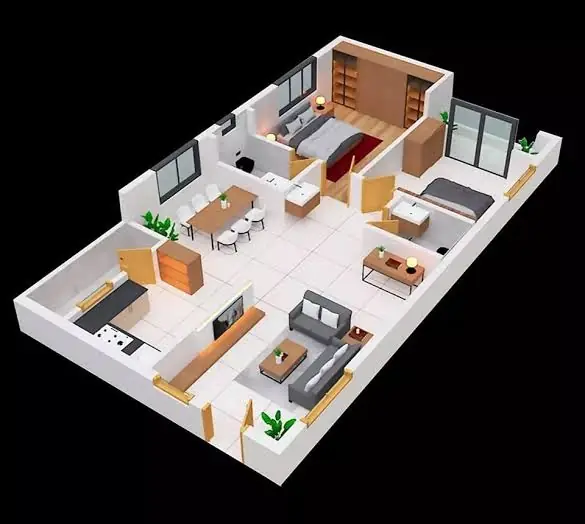
Designing a modern villa in Bangalore is one of the most exciting — and complex — undertakings a homeowner can embark on. With the city’s unique topography, its evolving regulations, its tropical climate, and a design culture that blends cosmopolitan aspirations with deep South Indian heritage, there’s far more to consider than square footage and floor plans.
At August Architecture, we’ve guided over 140 families and businesses through this journey. Here are the ten considerations that consistently separate extraordinary villas from merely functional ones.
1. Site Orientation and Solar Paths
Before floor plans are drawn, your architect should analyse the sun path relative to your plot. In Bangalore’s latitude, the east and west elevations receive intense morning and afternoon sun, while the north receives diffused light year-round. The optimal orientation places living areas and bedrooms to the east and south, minimising western exposure. Getting this right at the outset can reduce air conditioning loads by 30–40% for the building’s lifetime.
2. BBMP/BDA Setback Compliance from Day One
BBMP and BDA setback regulations define how far your structure must be from plot boundaries — front, rear, and sides. These are non-negotiable: building within a setback zone without approved deviation means either demolition or expensive regularisation. Your architect should calculate permissible coverage and floor area ratios from day one, so that design decisions are made within the actual buildable envelope, not an imagined one.
3. Soil Testing and Foundation Design
Bangalore’s geology is variable. Hard rock is common in many areas, but the city also has pockets of expansive clay soils, loose fill from old lake beds, and laterite that performs differently under load. A geotechnical investigation — involving bore holes and soil bearing capacity tests — is not an optional extra. It determines whether your foundation can be a simple isolated footing, a raft, or requires piling. Skipping this step to save ₹30,000 has led homeowners into structural remediation bills ten times that amount.
4. Ventilation Strategy Over Air Conditioning
Bangalore’s climate is exceptionally forgiving. For approximately nine months of the year, well-designed ventilation — cross ventilation through correctly positioned openings, stack ventilation through internal voids and clerestory windows, and ceiling fans — can maintain comfortable indoor temperatures without any mechanical cooling. The temptation to design for air conditioning and treat ventilation as supplementary should be resisted. A home that doesn’t need air conditioning for nine months of the year costs significantly less to operate and is inherently more resilient.
5. Rainwater Harvesting and Water Management
BBMP mandates rainwater harvesting for all plots above 2400 sq.ft. in Bangalore, but well-designed villas should incorporate it regardless of requirement. A properly designed RWH system with adequate storage and first-flush diverters can supply 30–60% of a household’s non-potable water needs (garden irrigation, toilet flushing, car washing) from monsoon rainfall alone. For villas, dual plumbing — separate treated mains water and harvested rainwater circuits — is worth the additional cost at the construction stage and impossible to retrofit economically.
6. The Integration of Indoor and Outdoor Living
Bangalore’s climate actively rewards villa designs that blur the boundary between interior and exterior. Extended overhangs, covered verandahs, transitional zones with operable screens or folding glass walls, rooftop terraces with shade structures, and garden courts that are fully integrated into the home’s spatial sequence all contribute to a living experience that the city’s year-round temperate climate makes genuinely possible. These spaces — neither fully inside nor outside — are often where a family spends most of its leisure time.
7. Materials That Age Gracefully
The materials that make the most beautiful villas in twenty years are not those that looked impressive on the day they were completed — they are the ones that age with dignity. Exposed concrete develops a patina. Natural stone weathers to a richer tone. Teak deepens from honey gold to a lustrous brown. Lime plaster develops hairline cracks that speak of time. Corrugated weathering steel rusts to a warm, stable oxide. Choose materials that will look better in fifteen years than they did on day one, rather than materials that can only decline.
8. Smart Home Infrastructure During Construction
Smart home systems — structured cabling, in-ceiling speakers, CCTV conduits, smart switch wiring with neutral loops, EV charging points, solar inverter and battery room allocation — are straightforward to incorporate at the construction stage and extremely expensive to retrofit. The time to decide whether you want smart home capability is during the MEP (mechanical, electrical, plumbing) drawing phase, not after the slabs are poured. Even if you don’t plan to install the systems immediately, routing the conduits and wiring now costs a fraction of what it will cost later.
9. Future-Proofing for Multigenerational Living
Bangalore villas are often built to last two or three generations. Design with this in mind: avoid split-level layouts that will be inaccessible to elderly family members; include a ground-floor bedroom and bathroom accessible without stairs; ensure corridor widths can accommodate a wheelchair if required; design for the possibility that a floor can be converted to an independent unit for a grandparent or returning adult child. These aren’t constraints — they’re design opportunities that add long-term value without significantly affecting construction cost.
10. The Right Architect-Builder Relationship
The relationship between architect and builder is the most consequential professional relationship in your project. When it works well — when the architect’s design intent is understood and respected by the builder, when the builder’s practical knowledge informs the architect’s decisions, and when both work transparently in the client’s interest — the result is a building that exceeds what either could achieve alone. August Architecture works with a curated network of trusted builders and project managers in Bangalore whose values and standards align with ours. We can guide you through the selection of the right builder for your specific project, oversee the build, and ensure that what is constructed matches what was designed. Building an extraordinary villa is a team endeavour. Make sure you have the right team.