The Climate Logic of Passive Design in Bangalore
Passive design means designing a building so that the climate does the work of keeping occupants comfortable — without relying on mechanical heating, cooling, or ventilation systems. In Bangalore’s climate, this is not an idealistic aspiration: it is an entirely achievable goal. A well-designed home in Bangalore should require air conditioning for perhaps two to three months of the year at most, and should maintain comfortable conditions for the remaining nine months through design alone.
1. Solar Orientation: The Foundation of Everything
In Bangalore’s latitude (approximately 12.97°N), the sun rises in the northeast during summer and the southeast during winter, arcing across the southern sky. Key implications for design:
- South-facing glazing receives sun year-round but at a high angle in summer (easier to shade with overhangs) and a lower angle in winter (allows passive warming)
- North-facing glazing receives only diffused light — ideal for studios, libraries, and spaces requiring consistent, glare-free illumination
- East-facing rooms receive morning sun (cool in the afternoon) — excellent for bedrooms and kitchens
- West-facing exposure is the most problematic: afternoon sun is low in the sky and difficult to shade; minimise west-facing openings or use deep vertical fins
2. Deep Overhangs and External Shading
Once solar orientation is established, overhangs and external shading elements control how much solar radiation actually reaches the building envelope:
- South-facing overhangs: Design overhang depth so that the sill is in shade at solar noon in summer (when the sun is high) but sunlit in winter (when it is lower). In Bangalore, an overhang of approximately 0.8–1.0 metres achieves this for standard window heights.
- East and west elevations: Horizontal overhangs are ineffective for low-angle morning and afternoon sun — use vertical fins, deep recesses, or fixed louvres oriented to block the relevant angles
- Roof terraces and green roofs: Planting over a flat roof dramatically reduces heat gain through the slab — one of the most impactful interventions in Bangalore’s climate
3. Cross Ventilation: Designing for Airflow
Cross ventilation requires inlet openings on one side of the building and outlet openings on the opposite side or roof. In Bangalore, the prevailing breeze direction varies by season — broadly southeast to northwest during summer, northeast to southwest during the post-monsoon period. Effective ventilation strategies include:
- Stack ventilation: Hot air rises; openings at high level (clerestory windows, roof vents) allow hot air to escape, drawing cooler air in at lower level
- Venturi effect: Narrowing the flow path (through a courtyard, between buildings, or at a window frame) accelerates airflow velocity
- Plan layout: Avoid dead-end corridors. Every room should have openings on two sides if possible. Internal courtyards serve as ventilation chimneys.
4. Thermal Mass: Storing the Night’s Cool
Thermal mass is the ability of a material to absorb and store heat energy. Dense materials — exposed concrete, stone, brick, rammed earth, tiled floors with mass below them — absorb heat during the day (preventing interior temperature from rising rapidly) and release it slowly at night. In Bangalore’s climate, where nights are typically 8–12 degrees cooler than afternoon peaks, thermal mass works most effectively when combined with night ventilation: open windows and vents at night to flush the day’s stored heat and cool the mass for the following day.
Rammed earth, in particular, has become a sought-after material in Bangalore and Goa precisely because of its combination of high thermal mass, beautiful natural texture, and direct connection to the local landscape. August Architecture has incorporated rammed earth walls in several projects as primary interior surfaces, combining aesthetic ambition with genuine passive design performance.
5. Planted Roofs and Green Walls
A planted roof over a flat slab is one of the most impactful passive interventions available in Bangalore. The soil and plant layer insulates the slab from solar heat gain, reducing the temperature of the slab surface from a potential 60–70°C (for an exposed black bitumen roof) to 30–35°C. The result is a dramatically cooler top floor — a floor that often requires the most air conditioning in conventional construction. Green walls on south-facing and west-facing elevations provide similar benefits for vertical surfaces. August Architecture regularly incorporates planted roofs into its residential designs in Bangalore and Goa, combining passive design performance with a biophilic aesthetic that fundamentally changes the character of the building.
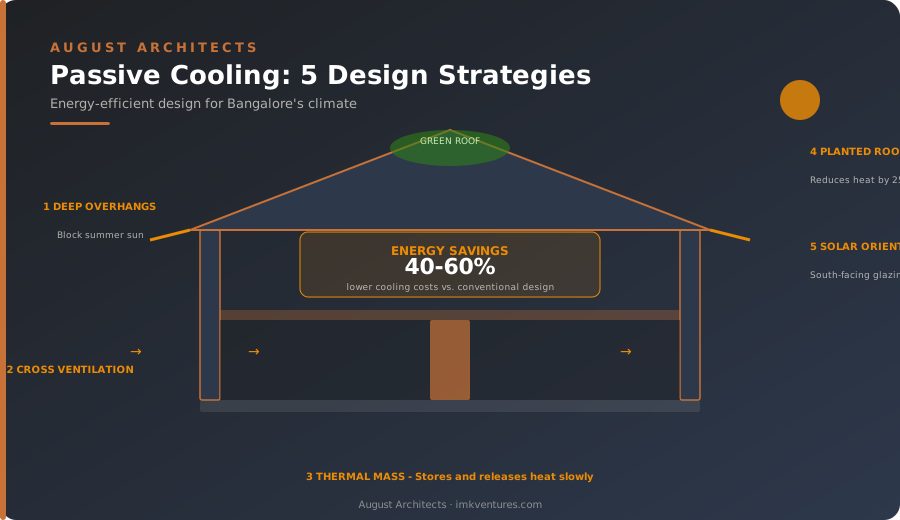
5 Passive Cooling Strategies at a Glance
Build a Home That Stays Cool — Naturally
August Architects integrates passive design principles into every project — designing homes that are thermally comfortable without mechanical cooling for 8–9 months of the year in Bangalore’s climate. Start your design consultation today.