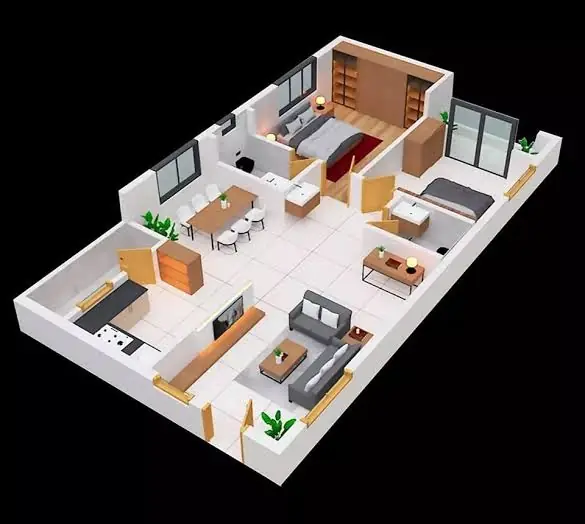
Why Room Design Matters More Than Equipment
A ₹5 lakh projection setup in the right room will outperform a ₹20 lakh setup in the wrong one. That’s not an exaggeration — it’s a physical reality. Sound waves behave according to laws of physics that no amount of expensive equipment can override. Get the room right first, then the equipment becomes a meaningful investment. This is the foundational principle of every serious home theatre design.
Ideal Room Dimensions: The Mathematics of Acoustics
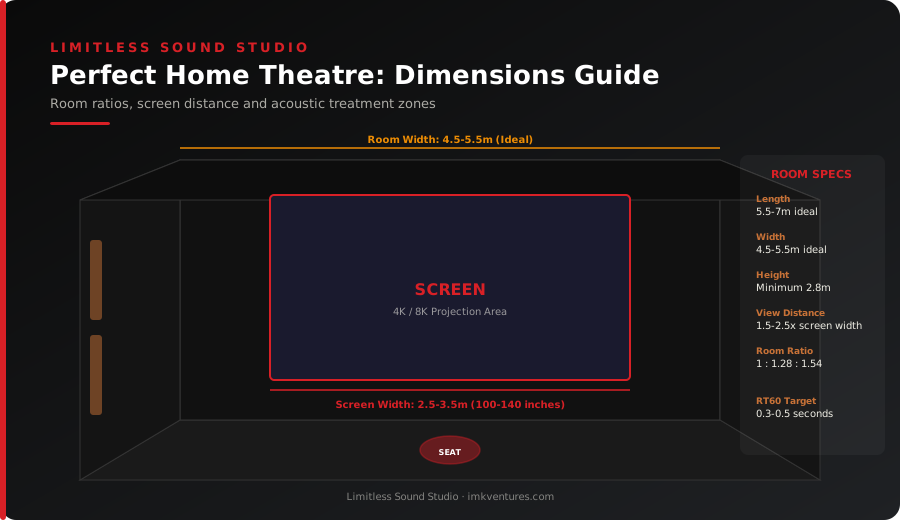
Room modes — resonant frequencies that build up at specific points in a room — are determined by the relationship between room dimensions. Rooms where all three dimensions share common factors create severe bass buildup at those frequencies. Recommended aspect ratios for home theatre rooms:
- Bolt ratio (1 : 1.28 : 1.54): A proven acoustic geometry; for a 10-foot ceiling room, target approximately 13 feet wide and 15.4 feet long
- EBU ratio (1 : 1.6 : 2.5): Favoured for larger rooms; provides excellent bass distribution
- Minimum dimensions: 12 feet wide × 18 feet long × 9 feet high for a true 7.1.4 Atmos setup
- Avoid square rooms entirely: Equal dimensions in any two planes create extreme modal stacking
Screen Size and Viewing Distance
The Society of Motion Picture and Television Engineers (SMPTE) recommends a viewing angle of 30–40 degrees for the primary seating position. THX standards suggest 36 degrees. In practical terms:
- 100-inch screen: Optimal distance 2.5–3.5 metres (depending on resolution — 4K allows closer seating)
- 120-inch screen: Optimal distance 3–4 metres
- 150-inch screen: Optimal distance 3.5–5 metres; requires a projector with adequate throw ratio
- Screen height: Centre of screen should be at eye level when seated — typically 90–110 cm from floor to screen centre
Acoustic Treatment: RT60 and Speech Intelligibility
RT60 is the time it takes for sound to decay by 60dB after a sound source stops. For a home cinema, the target RT60 varies by frequency but is generally 0.3–0.5 seconds across the mid-frequency range (500Hz–2kHz). An untreated room typically has RT60 values of 0.7–1.2 seconds. The treatment elements to achieve cinema RT60 targets:
- Bass traps (corner-mounted): Address room modes and excessive low-frequency buildup — the most important treatment in any small room
- Broadband absorption panels: 2–4 inch thick rockwool or fibreglass panels mounted at first-reflection points (side walls, ceiling between screen and seating, rear wall)
- Diffusion: Rear wall diffusers scatter reflections without deadening the room — prevents the over-damped, lifeless sound of a fully absorbent room
- Floor covering: Heavy carpet is one of the most cost-effective acoustic treatment elements available
Projector vs. Display: Choosing Your Screen Technology
For screens above 120 inches, a projector remains the most cost-effective technology. For screens below 100 inches, a high-quality OLED or QLED display often delivers superior picture quality in rooms that aren’t fully light-controlled. Key comparison points:
- Projectors: Larger image size, better in fully dark rooms; short-throw laser projectors (Epson LS800, BenQ V7050i) can be placed close to the screen and deliver excellent brightness; 4K laser projectors in the ₹1.5–5 lakh range offer excellent value for dedicated rooms
- OLED displays: Perfect blacks, unmatched contrast, works in ambient light; LG C/G series, Sony Bravia XR; best for rooms that can’t be fully darkened; limited to approximately 83 inches at accessible price points
- Ambient light rejecting (ALR) screens: Allow projector use in rooms that can’t be fully blacked out; significant cost premium over standard gain screens
- Triple recommendation: Dedicated, blacked-out rooms — choose projector. Living room conversions — choose OLED. Hybrid rooms — choose projector with ALR screen.
Home Theatre Room Dimensions & Specifications
Design Your Perfect Home Theatre Room
Limitless Sound Studio provides complete home theatre room design — from acoustic treatment and dimension optimisation to screen selection, projector installation, and full AV integration. Talk to our team today.