Why RERA Changed Everything for Karnataka Property Buyers
Before RERA — the Real Estate (Regulation and Development) Act, 2016 — Indian real estate was a sector characterised by systemic opacity. Builders could delay possession for years without penalty. Carpet area was calculated inconsistently. Funds collected for one project could be diverted to another. RERA changed this fundamentally, establishing accountability mechanisms that, while imperfect, represent a genuine transformation of the sector’s regulatory framework. Karnataka’s implementation, managed by KRERA (Karnataka Real Estate Regulatory Authority), has been among the more rigorous in the country.
What RERA Requires of Developers
RERA imposes a comprehensive set of obligations on developers and builders:
- Register all projects with more than 8 units or covering more than 500 sq.m. of land
- Deposit 70% of all funds received from buyers into a separate escrow account, disbursable only against certified stage completion
- Provide carpet area measurements (not super built-up area) in all sale agreements
- Deliver possession on the date committed in the sale agreement, or pay interest at SBI MCLR + 2% for each month of delay
- Rectify any structural defect or deficiency in workmanship within five years of possession at no cost to the buyer
- Obtain all approvals before launching marketing or collecting any funds
The 7-Step RERA Due Diligence Process
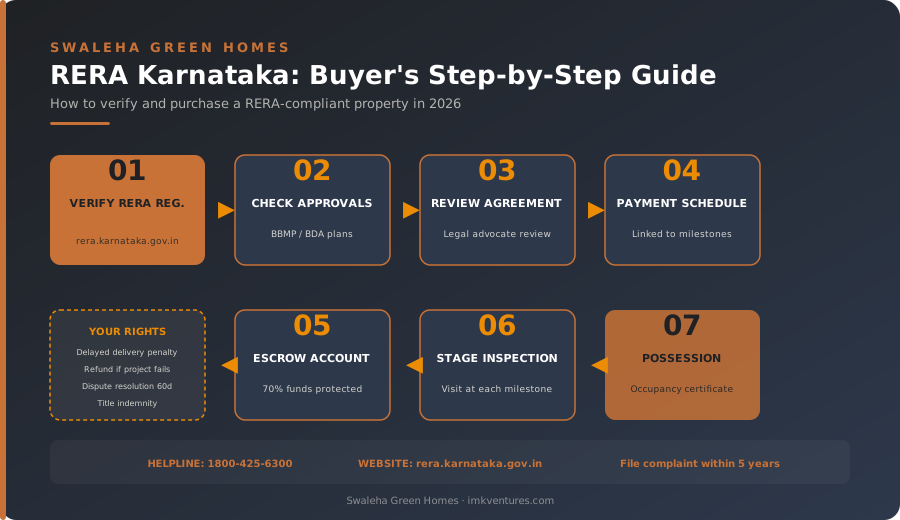
Step 1: Verify RERA Registration
Go to the KRERA website (rera.karnataka.gov.in) and search by project name or developer name. Confirm the registration is current and has not lapsed. Note the registered completion date — any project significantly past its RERA completion date is a serious risk signal. The RERA certificate should match the project name, site address, and developer details in the sale brochure exactly.
Step 2: Check All Approvals
From the KRERA portal, download and verify: the building plan sanction from the local authority, environmental clearance (if applicable), fire NOC, structural stability certificate, and layout approval. Any approval that is missing or expired should be clarified in writing before you sign any agreement or make any payment.
Step 3: Review the Builder-Buyer Agreement Carefully
The Builder-Buyer Agreement (BBA) is a legal document; have it reviewed by a property lawyer before signing. Key clauses to examine: the exact carpet area you are purchasing (not super built-up area), the possession date and delay penalty clause (ensure it matches or exceeds the RERA minimum of SBI MCLR + 2% per month), the allotment of parking, the force majeure clause (ensure it cannot be used to excuse normal construction delays), and the definition of what constitutes “completion” for payment milestone purposes.
Step 4: Understand the Payment Schedule
Under RERA, payment must be linked to construction milestones, not to time periods. The standard milestone-based schedule ties payments to verified stages: foundation completion, slab at each floor level, brickwork completion, finishing, and possession. Never agree to a time-based payment schedule (“pay 30% at six months, 50% at twelve months”) — this gives developers no incentive to complete on schedule and removes your primary leverage as a buyer.
Step 5: Verify Escrow Account Details
Confirm from the KRERA portal that a designated escrow account exists and that the bank and account number match what appears on your payment receipts. Funds deposited should show on the developer’s quarterly RERA progress reports. If funds are not being deposited to the escrow as required, this is a reportable RERA violation and a serious warning sign.
Step 6: Stage-Wise Physical Inspection
Do not rely solely on the builder’s construction update photographs. Visit the site at each milestone stage before releasing the corresponding payment. Bring a checklist: Is the structure as per drawings? Are material brands on-site matching the specification? Is the rebar placement and spacing correct before the slab pour? A brief on-site visit at each stage is your most effective quality assurance tool. If you cannot visit personally, appoint a project management consultant or architect to do so on your behalf.
Step 7: Pre-Possession Inspection
Before taking possession, appoint an independent structural engineer or property inspector to conduct a thorough pre-possession inspection. This inspection should cover: structural integrity (cracks, deflections, dampness), MEP quality (plumbing pressure tests, electrical continuity checks, drainage flow), finish quality (tile alignment, paint finish, door and window operation), and completeness of all promised amenities and specifications. Document every deficiency in writing and insist on rectification before taking possession — your leverage disappears the moment the keys are in your hand.
Your RERA Rights: Key Protections
- Right to accurate information: The developer must provide you with all approvals, plans, and specifications
- Right to possession on the committed date or compensation at MCLR + 2% per month for every month of delay
- Right to a refund if the developer fails to complete the project
- Right to structural defect rectification for five years post-possession
- Right to a formation of an association of buyers and transfer of common areas on project completion
- Right to file a complaint with KRERA for any violation of these protections
For complaints or information, contact KRERA at the Karnataka Real Estate Regulatory Authority, Bangalore. The KRERA website (rera.karnataka.gov.in) maintains a public register of all registered projects and enforcement orders. If you are navigating a property purchase in Karnataka and need guidance on due diligence, the IMK Ventures team is here to help.
RERA Karnataka: Your 7-Step Due Diligence Process
Buy Your Home with Confidence. Let Us Guide You.
Swaleha Green Homes guides buyers through every stage of the property purchase process — from RERA verification and legal due diligence to site inspection and possession. Contact us for a free consultation.